Extracellular vesicles (EVs), including exosomes, are nanoscale membrane-bound particles naturally released by cells and widely studied for advanced therapeutic and research applications. Their ability to carry proteins, lipids, RNA, and other bioactive molecules makes them highly promising for regenerative medicine, oncology, immunotherapy, and next-generation drug delivery. However, EV manufacturing requires a carefully designed workflow to address challenges such as low yield, product sensitivity, process consistency, purity, and scalability.
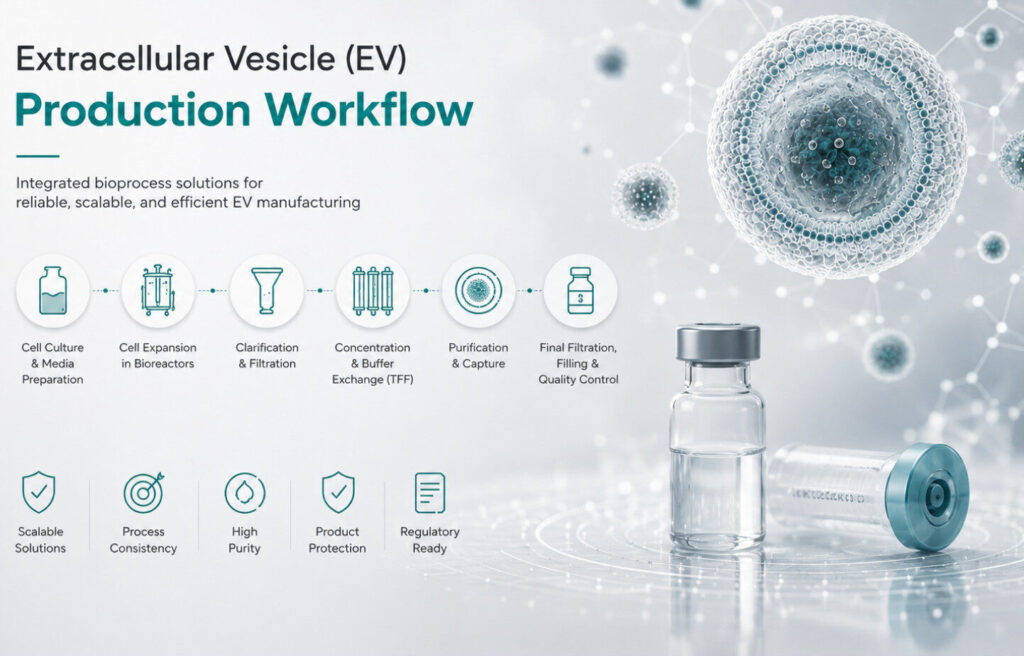
To support these needs, Sartorius provides integrated bioprocess solutions covering upstream and downstream operations across the EV production workflow. From media preparation and cell expansion in bioreactors to clarification, concentration, purification, and final processing, these technologies help improve reproducibility, product quality, and process efficiency. As the regional representative of Sartorius, SartoMax supports customers in selecting suitable systems such as single-use bags, bioreactors, sterile filters, TFF solutions, and process filtration products for extracellular vesicle manufacturing.
Extracellular Vesicle Production Workflow
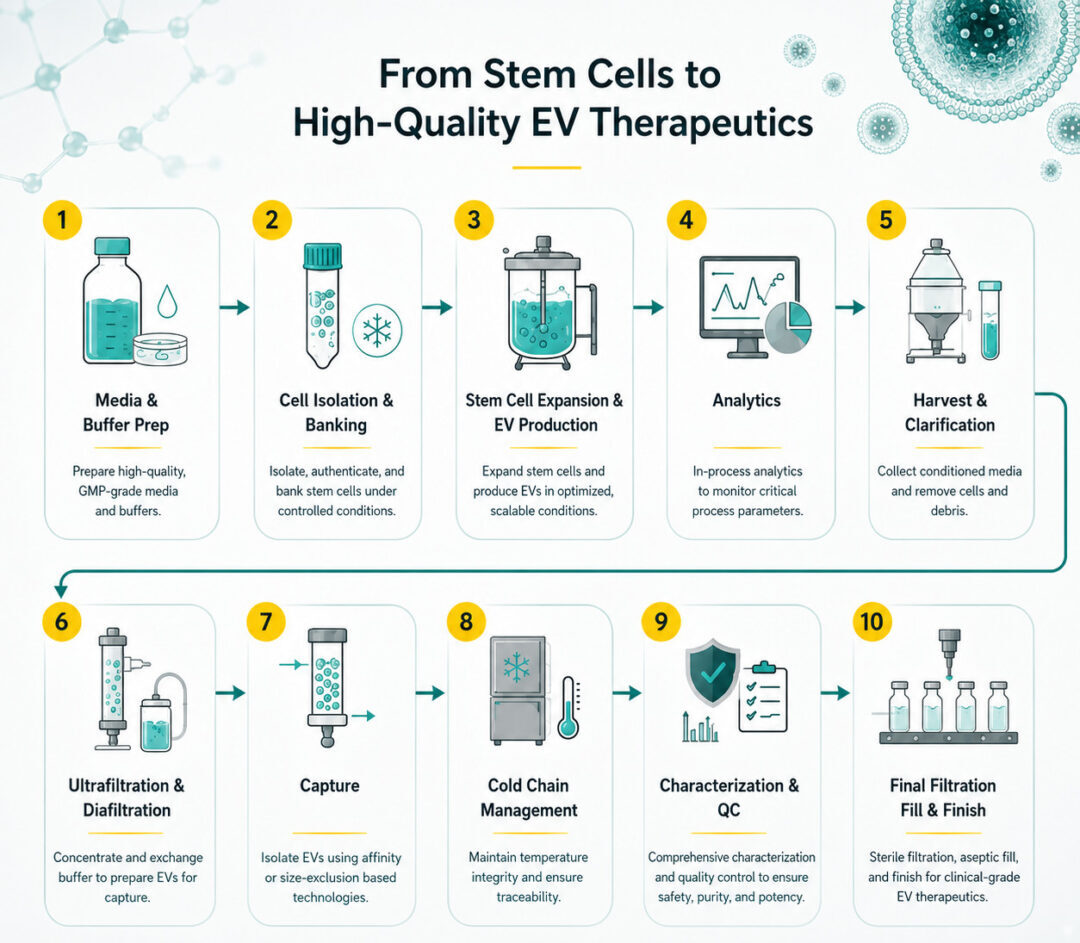
1. Media & Buffer Preparation
A successful extracellular vesicle (EV) manufacturing process begins with reliable media and buffer preparation. Sterile handling and preparation of culture media are essential to maintain cell health and ensure downstream process consistency. Sartorius supports this stage with Flexsafe® single-use bags, transfer assemblies, and Sartopore® sterile filtration solutions, enabling efficient preparation, storage, and transfer while minimizing contamination risks.
2. Cell Isolation & Banking
The quality of extracellular vesicles is directly influenced by the quality of the starting cell population. During cell isolation and banking, maintaining cell viability, traceability, and long-term stability is essential for reproducible manufacturing. Flexsafe® storage bags, cryopreservation solutions, and controlled fluid management systems help establish a reliable foundation for consistent EV production.
3. Stem Cell Expansion & EV Production
Following cell banking, stem cells are expanded under optimized culture conditions to generate extracellular vesicles efficiently. Scalable bioreactor platforms provide precise control of critical process parameters while supporting reproducible EV production. Sartorius offers BIOSTAT® STR, BIOSTAT® RM, Ambr® systems, and Flexsafe® single-use bioprocess bags to support process development, scale-up, and commercial manufacturing.
4. Analytics
Reliable process monitoring is essential for maintaining product quality and ensuring batch-to-batch consistency. Continuous measurement of cell growth, metabolites, dissolved oxygen, pH, and other critical process parameters enables better process understanding and optimization. Sartorius analytical solutions, including BioPAT® sensors and the Ambr® analysis platform, provide valuable real-time process insights.
5. Harvest & Clarification
Once EV production is complete, conditioned media must be harvested carefully while preserving vesicle integrity. Clarification removes cells and large particulates prior to downstream purification. Sartorius provides Sartoclear® depth filtration systems, Sartopore®, Sartobran®, Sartofluor®, Midisart®, and Maxicaps® filtration solutions for efficient clarification with high product recovery.
6. Ultrafiltration & Diafiltration (TFF)
Tangential Flow Filtration (TFF) is a critical downstream step for concentrating extracellular vesicles and exchanging process buffers while preserving vesicle functionality. Sartorius Sartocon® systems equipped with Sartocon® Slice or cassette technologies provide gentle, scalable concentration and diafiltration suitable for research through commercial manufacturing.
7. Capture
Following concentration, extracellular vesicles may require additional purification to improve selectivity and remove residual impurities. Membrane chromatography and affinity-based technologies can significantly enhance product purity. Sartorius supports this stage with Sartobind® membrane chromatography products, enabling rapid and scalable capture and purification workflows.
8. Cold Chain Management
Maintaining appropriate storage and transportation conditions is essential to preserve extracellular vesicle stability and biological activity. Controlled cold-chain management minimizes degradation and supports product integrity throughout manufacturing and distribution. Sartorius single-use storage solutions help facilitate secure handling during this stage.
9. Characterization & Quality Control
Comprehensive characterization and quality control confirm EV identity, purity, potency, and consistency before product release. Analytical testing supports process validation and regulatory compliance while ensuring reproducible manufacturing performance throughout development and production.
10. Final Filtration, Fill & Finish
In the final manufacturing stage, extracellular vesicles undergo sterile filtration, aseptic filling, and final packaging for storage or clinical application. Sartorius supports this workflow with Sartopore® sterile filters, Flexsafe® bags, transfer assemblies, and fill-finish solutions, helping maintain sterility, product integrity, and regulatory compliance during final processing.
Why Sartomax?
As the regional representative of Sartorius, SartoMax offers access to a broad portfolio of bioprocess solutions for extracellular vesicle production, including bioreactors, single-use bags, filtration systems, sterile filters, and TFF technologies. We help researchers, biotech companies, and pharmaceutical manufacturers identify practical and scalable solutions for each stage of the EV workflow.
Whether you are developing a new extracellular vesicle process or optimizing an existing platform, our team can help you select suitable Sartorius technologies to support efficient and reliable production.